Sunday, 11 October 2015

Britain is no longer a country for and omits to say "Goodbye" to an old and once revered TV presenter called Michael Dean

Page views : 2,862

MIchael, who has died at the age of 82 and was, in the 1970s and 80s, with his elegant charm and persuavive questioning, a popular BBC interviewer and narrator/script writer on the 'Late Night Line Up' and 'Man Alive' teams. Yet apart from three tweets from friends Joseph Murphy, WW2History.com and
Joan Bakewell who described him as a 'distinguished broadcaster' and 'a unique spirit', Twitter was silent. In the Press, only the MailOnline reported :
'BBC presenter Michael Dean, who interviewed Grace Kelly and Morecambe & Wise on his 1960s TV show Late Night Line-Up, has died aged 82. But he did not go gently into the night. Two years ago, the former amateur boxing champ landed a few good punches on a thug who robbed him at a London cash machine. "I hadn’t hit anyone in about 50 years," Michael said. "I threw my cap at him and hit him with a left hook and right cross."'

What you possible didn't know about Michael, that he :

* was born in Palmerston North, New Zealand in 1933, the son of Mavis from the family behind the successful 'Carter Holt Harvey Timber Company' and Kendrick , a remarkable GP who travelled abroad to seek out treatments for the ailments of his local community and at the age of 8 started to a attend Quaker prep school in Whanganui, where he began to absorb the values of tolerance and hatred of injustice about which he would later become eloquent.

* at the age of 11 joined Palmerston North Boys' School and after leaving at the age of 18 in 1951, became a journalist cadet on the local newspaper, then at the age of 20, contracted TB and confined to a sanatorium, began to read intensively, discovered the joy of books and ideas, Shakespeare and T,S.Eliot, who he called "big Tom” and once recovered, refined his skill in the boxing ring.


* spent a year as a sports reporter for a Cape Town newspaper in South Africa, before returning to New Zealand to join National Radio, married his first wife, Shirley and moved to Sydney, Australia, then after three years, with his marriage at an end, brought his charm, good looks and journalistic experience to Britain in the grip of the 'Swinging Sixties' and by the mid-60s was a recognised face on 'Late Night Line-Up having joined Denis Tuohy and Joan Bakewell at the BBC on the team at the age of 31 in 1964.

 saw the programme go well beyond its initial remit of 'examining BBC2's output' to incorporate interviews, live music and poetry performances and discussions of other TV channels and current affairs issues and produce an astonishing 364 programmes a year over eight years with interviews of figures mainly, but not exclusively, from the stage and screen between 1964 and '72

The surviving record of these programmes, because they went out live and tapes were wiped, is scanty.


* made a 1965 interview with Peter Sellers : https://www.youtube.com/watch?v=jYYGO29u870 and Peter Ustinov which began : "Peter Ustinov, you've always seemed to be a man who had an abiding disinterest in television, now all of a sudden, you're appearing on both BBC channels. Have you changed your views about the medium or is it the pressures of your several careers aren't so intensive now ?"
Peter : "No, I don't think so. I've absolutely no prejudice against television except that, just as in the theatre or anywhere else, I feel that if you have nothing to say, you shouldn't."
and later asked : "What about writing for television ? Do you think it is the least satisfying because it is so ephemeral ?" (Im10s)
and "A purely hypothetical question : If television was charged with, let's say subverting the public imagination and dulling the national sensibilities, would you care to defend it ?" (4m15s)
http://www.bbc.co.uk/iplayer/episode/p00nxq5b/late-night-lineup-16101965

* interviewed Morecambe and Wise in 1966 and one minute into the clip :
http://www.bbc.co.uk/programmes/p00nxq4l
Michael : "When did you discover that you worked well together, that there was a kind of chemistry between you ?"
Eric : "When we got married. We realised then."
Ernie : "No, you don't realise you've got a chemistry. You just want to do this double act and develop."
Eric : "We lean on each other a lot."
Ernie : "He's asking some funny questions."
Eric : "I'm not giving any funny answers."
Ernie : "You're digging deep. I don't know."
and at the end of the interview :
Ernie to Eric : "They were a bit hard those questions."
Eric : "They were. Bit strong. Yeah."

* said in his introduction to a 1966 interview : "Tonight in Line Up, Spencer Davis, an arts graduate and leader of a pop group topping the charts this week, Paul Jones, singer from the Manfred Mann Group who was sent down from Oxford University and Neil Farrow a journalist and a psychology student. They're here to discuss the newest of the television pop shows, 'A Whole Scene Going.' Later there'll be an interview by Joan Bakewell with Joseph Losey."
https://www.youtube.com/watch?v=dkFWOEBLbFs&t=0m33s

* conducted a short interview with Barbra Streisand in July 1966 and began :
"Now that you're pregnant, I presume plans for the film 'Funny Girl' you were going to do have been postponed. Would that be right ?"
https://www.youtube.com/watch?v=3IL_KaLVPBI

* developed an interview technique the 'Line Up' team called “the silent poisoner” in which he would ask a straightforward question and, on receiving an evasive answer, would hold his nerve and remain silent and wait afte which the interviewee, invariably, in a panic at the awkwardness of the pause, would blurt out anxiously whatever came into their heads and often the most revealing remark of all.

In addition :

* hosted a 1967 discussion about the two-part 'Man Alive Report on Homosexuality in Britain' in which he began : "One thing is certain, public attitudes to homosexuality in this country have changed and are changing. It's still a crime in Britain for male homosexuals to make love, but with a Reform Bill waiting to be given a third reading in the House of Commons, prosecutions, now, are rare. The law does not cover female homosexuals. The existing Act was passed by a Victorian Parliament which seems to have found it impossible to legislate for 'the unmentionable' : https://www.youtube.com/watch?v=kJr4q5np83g&t=0m39s and in which he went on to examine : 'whether it was appropriate to show the programmes at 8pm ?' and cover the wider issues of people being blackmailed because of their sexuality, homosexuals working in positions of trust and the consideration that one in 20 people might be gay. https://www.youtube.com/watch?v=kJr4q5np83g&t=35m19s

* started his 1968 presentation of the Small Faces in 'Colour Me Pop' with "the sound of the Small Faces, a young pop group, quirky, offbeat and very successful. Tonight they are one of our guests on 'Colour Me Pop' and here is one of their new numbers" : https://www.youtube.com/watch?v=8jYgctXpajs&t=0m32s

* after the cancellation of Late Night Line Up in 1972, joined the 'Argument' team and in 1974 chaired a discussion on 'Women's Rights: Radical Change or Gradual Reform ?' with MP Sally Oppenheim who worked on sex discrimination legislation and wanted to elevate women's current status, not change the nature of womanhood and writer and academic, Juliet Mitchell who challenged the whole notion of what it meant to be a woman and asked how much of womanhood is a social construct and began the discussion with : "I take it Juliet Mitchell, that you would accept amelioration in the lot of women, although ideally, you would prefer a social revolution in which womens' role was fundamentally changed. Is that right ?"
http://www.bbc.co.uk/archive/70sfeminism/10409.shtml

*  returned to New Zealand, where he had his own television chat show, 'Dean on Saturday', then moved to Australia to work for Kerry Packer's Channel Nine, where he anchored the coverage of the 1976 Montreal Olympics before returning to Britain to work again for the BBC reporting for 'Man Alive' and '40 Minutes.

* in 1980 conducted and interview with
with author, Doris Lessing, in which he began : "Doris Lessing came to England from Rhodesia, thirty years ago and has lived in London ever since. She has a restless intelligence and a passion for ideas that makes her one of the most challenging of living novelists" and at 6m50s into the programme asked : "I think you wrote once that Africa is an old fever, latent, always in the blood. Are you still carrying that old fever ?"
Doris (with emotion) : "Yes. Very much so. I dream about it all the time with terrible nostalgia and sort of anguish because that's finished. I'm a prohibited immigrant. With my heart I weep like a small child, you see, that I'm shut out of my own country."  
http://www.bbc.co.uk/archive/writers/12213.shtml

* in 1990 provided an elegant and witty script the third episode of a trilogy of films he produced about British Airways, 'Mission to Sell', in which he began : "The audience are all pilgrims who've come to worship at the shrine of British Airways. They're not voluntary pilgrims they all work for British Airways and this is a command performance. All day the pilgrims have been arriving at this secular cathedral to have their egos massages and their morale inflated and to learn how to become missionaries for British Airways. They're here to be reminded that British Airways in its privatised, glamourized new form, flies 25 million people to every corner of the world and in just 8 years, it's soared from bottom of the pack to one of the world's top half dozen airlines and that this year City analysts predict, will show a profit of £ 350 million. This is the good news. The gospel according to BA : Bring us your bored and you dispirited and we will preach them the religion of success. We will turn their lives into a mission to sell." https://www.youtube.com/watch?v=E7batnFqCP8&t=1m20s
and ended : https://www.youtube.com/watch?v=E7batnFqCP8&t=47m39s

* in 1990 scripted and narrated the BBC Series, 'The Transformers : the art of inspired teaching''The Butterfies of Zagorsk' about Soviet deaf-blind education, 'Out of the wilderness' based on the work of Reuven Feuerstein and 'Socrates for six year olds' in which he began :
"Matthew Lipman walked out a Chair of Philosophy at Columbia University sixteen years ago because he was convinced conventional education wasn't working. Children were failing to learn because they weren't being taught to think. The solution he decided lay in philosophy itself. That's why a religious retreat in the backwoods of New Jersey USA has been taken over by philosophers. They're here to study Lipman's 'Philosophy for Children Programme' to lean how to dop the thoughts of the great philosophers into the open minds of small childen." https://www.youtube.com/watch?v=fp5lB3YVnlE&t=1m50s

* in 1992 scripted for the 'Synopsis' Series, 'Jesus Christ Movie Star', a documentary narrated by Ian McShane which looked at the 20th-century portrayal of Jesus Christ in the cinema and began : "For nineteen hundred years the portrayal of Jesus Christ was controlled by the Church and it was a portrayal which was subordinate to the final authority of the words of the Gospel until, at the turn of the twentieth century, the Word itself was challenged by the new technology of the machine age. Inventions that raised the disturbing question : How do you portray the Son of God ?"
https://www.youtube.com/watch?v=25LrUswFs6o&t=0m44s

In addition to the programmes he fronted for Late 'Night Line Up' 1966-72 and in 1986, we can only imagine the character and content of the other programmes he made which we have also lost, some of which were, his  'Man Alive' Reports :

* 1978 : 'A Peculiarly English Disease' dealing with England's tendency to consider the 'right kind of work', as that which is as far removed as possible from the means of production.
* 1979 : 'Will the baby be all right?' and his attempt to find out why there are so many ' high risk' mothers in Britain and why most of them aren't getting the care they deserved.

and
* with Harold Williamson, 'Here we go round the mulberry tree', based on interviews with prisoners for whom prison simply didn't work, deter or reform and cost too much money and asked  : 'Why. when most other countries were closing prisons down, Britain was building more ?'

* 1980 : 'Look Mum. I'm brighter than they think' based on the fact that 10% of schoolchildren had trouble learning to read and write, but the Department of Education did not accept the existence of dyslexia.
* 1981 : 'Very Independent People' dealing with three severely disabled young people and their success in maintaining their independence.
and
* : 'The Biggest Theft of All'  dealt with shoplifting and examined some of the myths which surrounded it, that , for example, most shoplifters are women and asked : 'How can we stop a crime that is costing all of us more each year ?'
*  : 'Some of the Nicest People I Know Have Had VD' dealt with the alarming spread of STD and spoke to  doctors and some of the sufferers.

In addition :

His 1982 narration of 12 episodes of a calendar of French life, 'Year of the French' and narration for 'The World About Us' of 'Sky Doctor' dealing with the Australian Royal Flying Doctor Service.

and for the series 'This Week':

* 1981 :  'Vital Statistics' dealing with cosmetic surgery with a discussion the implications with a plastic surgeon, a psychiatrist and the two women who had undertaken breast surgery.
and  'Medicine or Miracle?' with three people who had made extraordinary recoveries from illnesses diagnosed and confirmed as terminal and asked doctors : 'How did they do it? Was it medicine or miracle? Freak or faith?'

and his, in 1982 :

* his report for the Tuesday documentary programme, 'Synopsis', 'Four Score Years and Then' dealing with the fact that more than half the hospital beds in the National Health Service were occupied by the elderly and by the end of the century the proportion would be even higher and centred on an interview with Professor Peter Millard, a geriatrician with radical ideas about the old and some of his patients.
* his documentary,'Lest we forget', in which a series of war widows talked about their losses in various 20th century wars in which British troops had fought.
'The George Formby Story' for 'Forty Minutes', a documentary profile of the Lancashire comic entertainer in which he attempted to solve some of the mysteries surrounding his life.
* his 1983, 'Noel Coward : A Private Life' for the 'Synopsis' series, compiled with the aid of Coward's home movies, rare footage from USA and personal reminiscences of Graham Payn, Harold Pinter, John Mills, George C. Scott and Maggie Smith.

and his, in 1984 :

* made 'Maori-The New Dawn' for 'The World About Us' examining how Maori faith in themselves, in his native New Zealand, was growing, as more and more educated young Maoris embraced old tribal traditions.
* wrote and narrated for 'Forty Minutes', 'Bertie and the Bomb', at a time when CND was active again after a decade of near silence and looked at the last chapter of Bertrand Russell's life with the help of archive film and interviews with friends and contemporaries  and in 'Love in Exile' dealt with the sad, lonely years when the man born to be king, Edward VIII, needed constant entertainment as a distraction from the humiliation of his reduced estate

In 1985, his :

* 'Tribute to James Cameron' for 'Synopsis' based on interviews with Michael Foot and Alan Wicker.

In 1987, his :

* 'A royal family album' for 'Synopsis' based on Queen Victoria's photo albums, shown for the first time with 
entries from her diaries and personal letters, and special sequences filmed inside Windsor Castle and Osborne House.
* writing and narration 'Once a Soldier' which focussed on three Falkland Island Conflict veterans who found, with their soldiering days over, that the intensely physical and ordered life of the army was not the ideal training for the life of a disabled civilian, especially one with a pocketful of cash.

In 1991
for the Baptist Missionary Society, 'A Weaver's Son' based on the  life and works of William Carey, born in poverty in 1761 and driven throughout his life by two obsessions - a powerful religious calling and an insatiable desire for knowledge.

How disappointing it is, that in a week when Britain's press, tv and social media have marked the passing and  been fulsome in their tributes to 79 year old tv newsreader, Gordon Honeycombe and 72 year old presenter Hugh Scully, that they have remained steadfastly silent about the passing of the talented Michael Dean.

Sunday, 4 October 2015

Britain's Birmingham is no longer a city for and says "Farewell" to the scarce old, custodian of its history, Chris Upton

'The days when Britain dominated the world in manufacturing and Birmingham sat at the top of the industrial tree have sadly departed, although the back streets of Digbeth still ring reassuringly to the sound of hammers and fizz with acetylene torches.'

In 2008 Chris, who has died at the age of 62, introduced himself as the President of the Birmingham National Trust Association with : 'Having lived and worked in Birmingham for 27 years, I have watched as history and heritage have become ever more important and prominent in our City and in the wider West Midlands. The National Trust and its membership are in the vanguard of this growing appreciation.'

What you possibly didn't know about Chris, that he :

* was born in Wellington, Shropshire in 1953, brought up and educated in Wolverhampton at the Boys' Grammar and after studying for his BA in Classics and English at Kings College, Cambridge and then MA, was admitted as a research student and PhD candidate at the University of St. Andrews in Scotland at the age of 24 in 1977 and having completed his research in 1980, moved to Birmingham, at first as a research assistant at Aston University, then in a post in the 'Archives and Heritage' Section of Birmingham Central Library (right) and continued to retain his enthusiasm for primary sources throughout his career : "I’m always more excited by a new piece of primary evidence, dug out of the archives, than a new historical theory developed by a current historian and it helps to provide an answer to that age-old historical question: ‘what was it like ?’"

* in 1982 published, with his wife, Fiona Tait, 500 copies of  'The Steganographia of Trithemius' an influential occult text written in the late 1400s, a book both for the conjuration of spirits and a code book with lists of spiritual messengers associated with the divisions of space and time which circulated secretly in manuscript form during the 16th century and was highly valued by Elizabethan astrologer, John Dee.

* at the age of 31 in 1984, successfully submitted his doctorate, 'Studies in Scottish Latin', in which he chronicled the 16th and 17th century endeavours of one, 'John Scot of Scotstarvet (right) to compile an anthology of Latin poetry' the 'Delitiae Poetarum Scotorum' which was 'arguably the largest anthology of verse produced by the Renaissance in England or Scotland' in which he thanked 'My wife, Fiona Tate' who had 'assisted substantially in my analysis of the Dundas Papers and also knows more about the St. Leonard's College Orators' Book than anyone'.

* moved from the Archives to an undergraduate teaching post, first at Aston University and then as Lecturer in History at Newman University College Birmingham and finally as Reader in Public History and at the same time moved the focus of his history study away from obscure medieval and Renaissance manuscripts to the history of the West Midlands in general and Birmingham in particular, while at the same time keeping his feet in the archives, writing in 2000 that 'for a city that feels as modern as Birmingham does, it’s always comforting for a historian to know that we have 1,000 years of documentary history to look back on. Indeed, it’s as well that we do have the documents since the city planners have done their best over the years to erase anything more substantial.'

* produced his first 'Tolkien Trail' in 1996 : "My name is Chris Upton I'm a historian and interested in the literary connections of Birmingham and this is a perfect spot for them. We're in Plough and Harrow Road alongside the hotel, an area very important to Tolkien's life. The night before Tolkien went off to the First World War he stayed for his honeymoon in the Plough and Harrow Hotel next to us. So this part of Ladywood, was very important to Tolkien and for the rest of his life and certainly when he was writing his books we've got the Two Towers that were the inspiration for the second volume of 'Lord of the Rings' and you can see the two towers in front of us. Perrott's Folly, the 18th century one and then the more elaborate tower of Edgbaston Waterworks behind it."

* in 2000, at the age of 47, described the history of the city he had adopted and loved and its Norman transformation from a 'little Saxon backwater into a more than decent trading outpost. Once the new owners - most of them called William and all of them De Birminghams - had hit upon the idea of converting their personal estate into a market town, then the growth of Birmingham was pretty well assured' through to its rise as an industrial city : 'Close enough to the coal seams of South Staffordshire and to the timber of North Warwickshire and near enough to the hills of Wales and Shropshire where the sheep and cattle grazed, Birmingham had what every estate agent craves: location, location, location.'

* in 2008, with a sense of fun, explained the genesis of the James Roberts design for the City's 20th century Rotunda : "James Roberts is sitting trying to think of a building which will fit between the Bull Ring and the bottom of New Street on a very odd shaped site ..." https://www.youtube.com/watch?v=ojXB7G7aEp0&t=0m17s

* published 'Living Back to Back' in 2010 in which he took the survival from demolition of 'Court 15' in Birmingham as his starting point and, with a mixture of documentary evidence and oral history, told the story of those who lived there from the glass eye maker to the Jewish watch-maker from Poland, through the boom years of Victorian expansion to the Hungry Thirties while answering questions like :  'What was it like to live in a house with one bedroom and no running water?' and 'How did eleven families share two toilets?' while placing the story firmly in the context of  the development of urban housing.

* at the age of 57 in 2011 published his 'tour de force', 'A History of Birmingham'and traced its rise from a village worth one pound in the Domesday Survey, to the 'the toy shop of Europe' in 1800, having cornered the markets for gun-making, jewellery, buttons and buckles and then became the powerhouse of the Industrial Revolution, selling its wares in vast quantities to the entire world and in the process, pioneered political, educational and municipal government reform, a story which involved Boulton and Watt, Dunlop, Cadbury's, G.K.N., Lloyd's Bank, Austin Rover, Joseph and Neville Chamberlain, Thomas the Tank Engine, Fu Manchu and Mendelssohn's 'Elijah'.

* in the same year, captivated a group of Year 5 an 6 pupils at Paganel Primary School with his illustrated talk on five 'Local Heroes' and explanation of George Elkington's electroplating process as : "It was the way to get something which was very, very expensive, but didn't cost very much, ornaments, things to put on your table to impress people who'd come to see you or on you mantle piece and the way it works, and I only know a bit about it because I'm a historian and not a scientist...." https://www.youtube.com/watch?v=nIbZK24EBes&t=10m28s

* was appointed as 'Historical Consultant' for the six-part period tv drama, 'Peaky Blinders', set in Birmingham at the start of the 1920s and worked with the production team, writers and actors to ensure historical accuracy and commented : "It was a real honour to work on the series. Period dramas, such as Peaky Blinders, entertain and inform members of public, shining a light on periods of history that may have been forgotten. While the series itself isn’t based on a true story, the types of events, times and environment in which the drama takes place are real so we wanted to portray these aspects as accurately as possible."

* also said : "I was particularly keen to ensure that the actors’ accents were as accurate as possible and not confused with Black Country accents' and 'provided the cast with tapes of oral history interviews carried out by Newman students with local people who were alive at the time the series is set. That way they could hear how local people would really have spoken and base their accents on real people. Several of the characters in the series are significantly affected by the trauma of their experiences in the Great War and, by listening to the first-hand accounts of local people who shared those experiences, the actors were able to gain a greater understanding of the issues and challenges those characters faced when returning to so-called ‘normal life’ in the city after the War."

* while conducting his 'Gangs of Digbeth Tour' in the City, explained the origin of the name, 'Peaky Blinders' as : "The one we use in the film, that they got three razor blades sown into the peaks of their caps and if you crossed them, they could whip it across you face. The other is that it was simply, they wore these peaked caps that partly obscured them, so that they, as it were, blinded themselves or that they had a peaked cap but also a fringe of hair which also partly obscured what they could see." https://www.youtube.com/watch?v=jhyYhSbUMlI&T=0m05s

* went on the explain that the "illegal activity of choice in the nineteenth century and the first part of the twentieth" was gambling on horses and "there was a group called the Brummagen Boys who pretty well ran the courses in the Midlands and the North.Their leader was Billy Kimber. In the early twentieth century they tried to move in on the London and Southern courses where they hit the Sabini Gang of former Italian immigrants who were controlling the betting courses in the London area and the 'Battle of Kings Cross' took place in which Billy Kimber was shot and of course its carried on ever since with the Futrels and the Krays and all the rest. But that's a bit too close for comfort though I'm sure 'they were all lovely people'." https://www.youtube.com/watch?v=FgvSTvejO9Y&t=4m04s

* continued to contribute his weekly history for column the 'Birmingham Post' and in 2014 contributed to The Library of Birmingham's 'Those were the Decades : 1960's' event by exploring material from the archives for evidence of Birmingham’s counterculture in the 1960s and in June this summer hosted ‘Festival of Voices' in which an audience of over 200 at the Town Hall enjoyed an evening where the 19th century was brought back to life with music, drama, history, school children’s singing and circus skills with support from the Birmingham Cathedral Choir.

* last month contributed an article in the Guardian entitled : 'Diversity and dedication: the secret of Birmingham's success' in which he explained : 'Urban expansion has always relied on inward migration. To begin with, new blood came from Wales, Scotland, and Ireland. By the 19th century, migrants headed here from Eastern Europe, Russia and Italy. The 20th century flung that net even wider. In one Birmingham secondary school, George Dixon Academy, the pupils speak more than 40 languages. “You enter the school gates,” says one teacher, “and you step inside the rest of the world” and  'Whatever their background, Brummies have got their priorities in the right order: acknowledging their heritage while keeping their roots and their dancing boots in Birmingham, a city that has always welcomed diversity'.

* was looking forward to the publication of 'Joseph Chamberlain. International Statesman, National Leader, Local Icon' in 2016, the fruit of joint editorship with Ian Cawood, in which they deal with his career in the 1800 and 1900s as an international statesman, a national leader and, not unsurprisingly, the aspect for which he is still celebrated in his adopted Birmingham : as the dispenser of sanitation, gas lighting, clean water and cultural achievement providing a model of civic regeneration which has continued to inspire modern politicians.

* was, in his passing, paid tribute by 'Birmingham Post' Features Editor Sarah Probert :
“He was a first class columnist with an enormous sense of humour who had a real passion for his subject.”

and News Editor Ben Hurst :
 “What Chris didn’t know about the City’s past wasn’t worth knowing.”

* when once asked : "What history should be taught in school ?" had answered in true Brummie, civic tradition :

"I would stress, as you’d expect, the importance of local history and the local environment, in school history. I end up covering it with first year undergraduates instead and I think it makes them better citizens, as well as better historians."
 

Friday, 2 October 2015

Britain is no longer a country for and says "Farewell" to the Father of Wildlife Trust Conservation, Ted Smith


Ted, who has died at the age of 95, started work in conservation at the age of 38 in 1948 in the 'Lincolnshire Naturalists' Trust', with 129 members and £82 in the bank. The fact that today, the Wildlife Trusts number more than 800,000 members with over 2,000 nature reserves, is in no small measure down to his dedication, foresight, hard work and steely determination to conserve the land he had known and loved in his youth.


What you possibly didn't know about Ted, that he :

* was born in Arthur Edward Smith in 1920 in the market town of
Splisby, Lincolnshire and grew up eight miles to the north in Alford at the foot of the Lincolnshire Wolds, the son of Emma and Arthur, a plumber by trade, where his parents worked long hours and without holidays running a bakery and grocery shop and with his nearest sibling, his sister ten years his senior, spent much time on his own, exploring the countryside.

* later said : "I think I was conscious of birds in particular from quite an early age. The swifts nested under the eaves of old cottages and screamed over the rooftops in the evening always fascinated me. I took to roaming in the countryside with a cheap pair of binoculars and Coward's little 'British Birds' with Thorburn's illustrations, I became reasonably proficient as a bird watcher" and adopted the farmland lapwing, known locally as a 'pyewipe' as his favourite. https://www.youtube.com/watch?v=8SYuIN1EeNY&t=0m09s

* was educated at the boys' grammar school in Alford, Queen Elizabeth’s, which had received its charter from the Queen 'for the Education, Instruction and bringing up of Children and Youth for ever' in 1576 and in the sixth form, at the age of 17, in the school summer holiday of 1937, cycled the 14 miles to Gibraltar Point and with his binoculars looked for terns on the lonely stretch of sand and salt marsh beyond Skegness and, surrounded by sky and sea, fell in love with the place and even then noted three 'gaudy new houses' on a road cut into the sand dunes, typical of the unrestrained development then enveloping the British coastline.

* later looked back on his teenage life in the 1930s and was pleased that he had "lived in the inter-war years because so much of the old tradition, the old way of life was still there" : https://www.youtube.com/watch?v=6r2FJDleT5E7&t=2m17s and after matriculation from school, joined Leeds University as an undergraduate studying English Literature in 1938 and on the outbreak of the Second World War, the following year, was excused armed service on medical grounds due to jaundice and a suspected heart condition and during the War was profoundly affected by the death of  his friend, Peter Stocks, a gifted bird artist, killed while serving in the RAF.

* graduated with a first class degree in 1941, obtained a Masters degree then worked as a secondary school teacher in Leeds and then Norfolk, where he visited the country's first Wild Life Trust which had saved habitats by purchasing land and in 1948 at the age of 28 returned to his native Lincolnshire having secured a post as a tutor in adult education and began his work as a conservationist.

* was convinced that a new model for conservation was needed and later recalled : "The popular idea of a nature reserve in 1948 was of a place that you put a fence around and kept people out, but Gibraltar Point had to be different. We knew there was free open access for people anyway, so we had to reconcile conservation with access, but it also gave an enormous opportunity to interest people, to provide facilities for research and study and so on." https://www.youtube.com/watch?v=6r2FJDleT5E&t=5m33s

* founded the 'Lincolnshire Naturalists' Trust' in 1948 and in the same year, having met Mary Goddard, a botanist, on a trip to the Welsh island of Skokholm, proposed a few weeks later at Gibraltar Point and married in 1949, the year in which he moved quickly with his fledgling group to enlist the support of Lincolnshire County Council to thwart a proposal to build more than 800 bungalows which threatened its beauty and habitat.

* worked to ensure that the concept of a 'Local Nature Reserve' in England declared by a Local Authority was written into the post-War Labour Government's 1949 'National Parks and Access to the Countryside Act', a designation which recognised its special significance as a new type of reserve https://www.youtube.com/watch?v=r-CTkkqTZ8s&t=6m36s

* was gratified that : "By 1952 the Gibraltar Point Reserve was flourishing and was widely regarded nationally as a model of its kind. Schools and universities were using it for teaching and research and the number of visitors was already in the tens of thousands. It was a fitting recognition of its success that in August 1952 it became the first Local Nature Reserve in England."

* had witnessed the loss of familiar landscapes and their wildlife during the War, when the need to be self-sufficient in food had meant that hay meadows were ploughed up and ancient hedgerows removed, to grow crops and feed livestock and the after the War saw the use of chemical pesticides such as DDT, enable farmers to produce more and more cheap food for consumers, but at a heavy cost to birds, mammals and insects, poisoned in their millions and also the encroachment of the countryside by more homes, factories and roads. https://www.youtube.com/watch?v=r-CTkkqTZ8s&t=5m51s

* in 1954, at the age of 34, addressed his Trust's Annual Meeting with a surprising message : many naturalists, he argued, were indifferent to the great wave of destruction instigated by industrial agriculture and this must be fought by new County Conservation Groups whose members would be drawn from a wider section of society than the elitist natural history societies of the day and later recognised that despite the fact that : "the movement grew, slowly, through the 50s and 60s. It was a very exciting time and a very rewarding time."

* fought in Lincolnshire to save unspoiled coast, ancient meadows and heaths and to halt the destruction of native woodland, campaigned to save roadside flowers from being sprayed with chemicals, pressed for legislation to protect otters and extended his influence beyond Lincolnshire by touring persuading others to set up their own county conservation groups https://www.youtube.com/watch?v=6r2FJDleT5E&t=9m29s inspiring them to purchase land and gain community support and as a result saw Cambridgeshire and Leicestershire set up Wildlife Trusts in 1956, Surrey in 1959 and Berkshire, Buckinghamshire and Oxfordshire in 1960.

* orchestrated discussions between the new Trusts and got them to agree that they needed a national association and  saw the 'Society for the Promotion of Nature Reserves' hold its first national conference in Skegness in 1960. https://www.youtube.com/watch?v=r-CTkkqTZ8s&t=6m44s

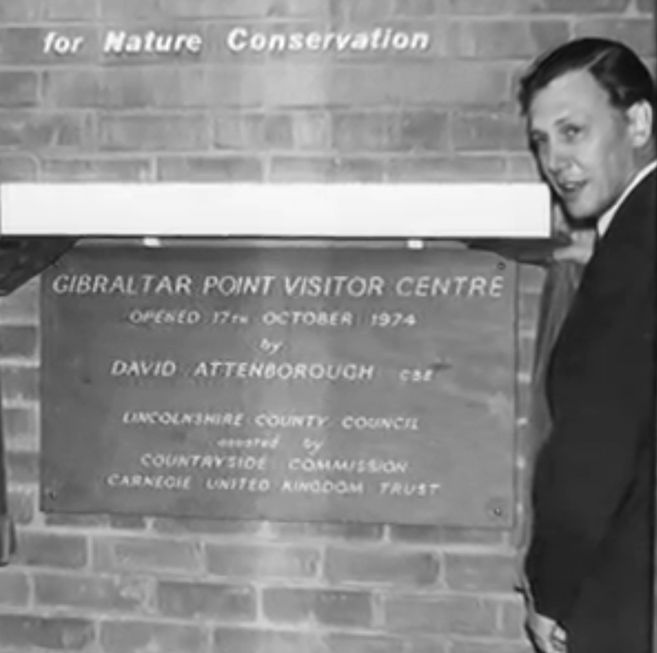
* in the 1970s had acquired a powerful friend and ally in Britain's best-known wildlife broadcaster, David Attenborough, who recalled that in the field : "He was very unobtrusive, very quiet, but very, very determined. We went of to various reserves. I soon learnt the thing to do was stick alongside Ted because he would see things quicker than most people and certainly quicker than me and what's more he'd recognise them. He was an expert field naturalist" and who also opened the new visitor centre at Gibraltar Point in 1974 : https://www.youtube.com/watch?v=6r2FJDleT5E&t=11m22s

* had found his own trust was powerless in 1963, when one haven for rare plants, the Lincolnshire, Waddingham Common, was ploughed up by a local farmer, encouraged by a handsome Government grant of £12 an acre and often had to watch helplessly as one Government department undid the work of another, allowing development on what were supposed to be 'protected sites' and realised that local trusts needed to join together to influence Government policy at the highest level and began the process of creating a national movement for wildlife, which culminated in him becoming General Secretary of 'The Wildlife Trusts' at the age of 55 in 1975.

* in 2012 at the age of 92 was presented by David Attenborough, Vice President and former President of 'The Wildlife Trusts', with a sculptured lapwing award at the premiere of the documentary film : ‘The Wildlife Trusts: 100 years of nature conservation’ https://www.youtube.com/watch?v=r-CTkkqTZ8s who said : "I am delighted to have this opportunity to demonstrate our appreciation of Ted’s profound impact on the first 100 years of nature conservation. Ted is quite exceptional and, I believe, is the living person who has made the biggest single contribution to The Wildlife Trusts Movement. Generations to come are going to benefit more than they will know. This countryside of Britain may not be as rich as Ted knew it as a child in the 1920s and 30s but it is immeasurably better than it would otherwise have been without him and The Wildlife Trusts. I believe that work will continue and be increasingly important to all of us living in this beautiful but crowded archipelago."

* had his service to Britain recognised when made an OBE for 'Services to Nature Conservation' in 1963, advanced to CBE in 1998, the year he also received an Honorary Doctorate of Science at the University of Lincolnshire and Humberside and was the first recipient of the 'Christopher Cadbury Medal for Service to Nature Conservation'.

* had been paid tribute by David Attenborough with :

"He understood, to a degree that verged on the magical, the diplomacies needed to coordinate and energise organisations"


What better epitaph might an old, pioneering conservationist  have ?

Wednesday, 30 September 2015

Britain is a country where old man have a new champion in Anna Dixon and the Centre for Ageing Better

Anna, who in her new post as Chief Executive of the 'Centre for Ageing Better', has the job of coming up with fresh ways of preparing Britain for its rapidly ageing society has said :

“We think there’s lots of opportunity to change not only how we experience old age but some of the perceptions of what it is to grow old. We have a great opportunity to make a big difference on one of the biggest public policy issues internationally. We want the work we do to mean more of us look forward to a good old age.”

At her disposal she has a 10-year endowment, chaired by the 71 year old Lord Filkin, worth £50m from the Big Lottery Fund. The good Lord also chaired a House of Lords Select Committee which concluded in 2013 that the country was "woefully underprepared" for the demographic change that will see a doubling in the number of very old people aged over 85 by 2030.

Anna agreed with the Committee :  “There’s a profound change occurring because of increased life expectancy. On the one hand that’s something fantastic and something we should be celebrating. But the demographic shift with a larger proportion of the population in older age is something we’re not preparing for either individually, in terms of saving enough or thinking about what sort of houses we might need to be living in, or as a society.”

So how does Anna feel that the Centre might help improve the quality of life for old men and women and kelp them age better ? In answer to the question she cites her grandmother as a role model who, disabled and virtually housebound for many years, still managed to live a very full life.
“It’s not necessarily being free of disability or disease, it is about feeling you’ve got value in life, that you are loved, that you can give as well as receive and be connected to other people.”

So elderly men of Britain, Anna is looking to :

* strengthen your links to your COMMUNITY :
 “People can be facing quite a challenging health situation, they might not be that well off by objective measures of income but if they have strong social relationships and a positive mindset that can make a big difference and that’s an area we would like to look at.”

* keep you in WORK :
"A lot of things are being tried out now, like mid-career reviews, apprenticeships for older people and employment practices to support older people to stay longer in work, but there’s no evidence yet about which of those actually work. That’s the sort of practical thing where we can help to evaluate some of the new approaches and spread that learning among employers."

* improve your HOUSING :
by promoting more tailored housing and better use of technology. “There’s a huge focus on residential care, but actually if you look at the population of over-65s it’s only about 3% who are in residential care, so what are we saying about the 97% living in their own homes? If we could do something to help them stay in their homes then we’re actually going to reduce the need to expand residential and institutional care.”

* bust some of the MYTHS and NEGATIVE PERCEPTIONS about you :
such as the view that you are a burden on the National Health Service when, in fact, more people under the age of 65 than older people like you are living with more than one chronic condition.

And for the future elderly man and women of Britain :
“We have to help younger people in their planning and preparing for later life. Some of us might occasionally see financial adviser about pensions but mostly we don’t want to think about it and we certainly don’t want to imagine ourselves having dementia and needing personal care. We need to help people to do what they need to do and maybe make some different choices earlier so they get a better chance of experiencing a good later life.”

Cynical old men in Britain might feel that this doesn't amount to much and after the £50m has been spent, there won't be a perceptible difference in the lives of millions of elderly men and women. Others, more charitably, might agree but still say :
"It may not be much, but it is a step in the right direction and all power to your elbow Anna."