Saturday, 15 October 2011

Britain is no longer a country for and says "Goodbye" to an old folk musician and 'Pentangle' player called Bert Jansch


Bert Jansch, influential guitarist and founder member of the groundbreaking folk band 'Pentangle', has died at the age of 67.

What you possible didn't know about Bert, that he :

* was born in Glasgow, the descendant of a German family from Hamburg who settled in Britain in Victorian times, was brought up in Edinburgh, where as a teenager, he acquired a guitar and started to visit a local folk club and was introduced to the music of Pete Seeger and Woody Guthrie.


* left school and took a job as a nurseryman, gave it up in 1960, with the intention of being a full-time musician and spent the next two years playing one-night stands in British folk clubs.

* from 1963-65, hitch-hiked around Europe, living on earnings from busking and playing in bars and cafes, accompanied by his first wife who was 16 years old and too young to have her own passport and split up from her after he was repatriated to Britain after catching dysentery in Tangiers.

* moved to London where there was a burgeoning interest in folk music, met the engineer and producer, Bill Leader, at whose home they made a recording of Jansch's music on a reel-to-reel tape recorder and who sold the tape for £100 to Transatlantic Records, who produced an album directly from it.

* saw his first album sell 150,000 copies and had his protest song " Do You Hear Me Now ?", brought to the attention of mainstream pop later when Donovan covered it on his 'Universal Soldier'
http://www.youtube.com/watch?v=egdK_H8ni60
and also included his 'Needle of Death' :
http://www.youtube.com/watch?v=QTKPTJ_gUXQ

* followed his first album with two more and the second, 'Jack Orion' contained 'Blackwaterside', later to be taken up by Jimmy Page and recorded by Led Zeppelin as 'Black Mountain Side' and could not afford to pursue a 'breach of copyright case' against them.
http://www.youtube.com/watch?v=hkX7Q2J7k48

* in London, met up with another innovative acoustic guitar player, John Renbourn
and developed an intricate interplay between their guitars, referred to as 'Folk baroque'.
Hole in the Coal :
http://www.youtube.com/watch?v=5YzzKAUm_VM

* started to play with John, singer Jacqui McShee, Danny Thompson on bass and Terry Cox on drums, as 'Pentangle',reached their highest point of commercial success with their 'Basket Of Light' album in 1969.
http://www.youtube.com/watch?v=d9gCN9-Jnfg

* reached his peak of popularity with Pentangle in 1970 with the soundtrack for the film 'Tam Lin', made tv appearances, toured Britain and USA and witnessed their album 'Cruel Sister' become a commercial disaster and the group split up in 1973.

* had an influence on Mike Oldfield, Paul Simon, Neil Young, Nick Drake and Donovan.

Reynardine :
http://www.youtube.com/watch?v=JmVA7BHsF1I&feature=related

Friday, 14 October 2011

Britain is a country where many old men of tomorrow are children in poverty today


According to 'Gross Domestic Product', Britain is the fifth richest country in the world.


A report from the 'Institute for Fiscal Studies' indicates that :

* the Government shakeup of the tax and benefits system will result in a further 400,000 children falling into 'relative poverty' during this Parliament, leaving Britain on course to miss legally binding targets to reduce child poverty by 2020.

* the number of children in 'absolute poverty' in 2015 will rise by 500,000 to 3 million and by 2020, 3.3 million young people, almost one in four children, will find themselves in 'relative child poverty' which is 2 million short of the 2020 target to reduce child poverty to 10% or less of all children and represents an increase of 800,000 on the figures for 2011.

* a child is considered to be in 'relative poverty' if he or she lives in a household whose 'income is below 60% of the average in that year' and in 'absolute poverty' if he or she lives in a household whose real-terms 'income is below 60% of the 2010/11 average', a period set as a benchmark in this year's Child Poverty Act.


Alison Garnham, Chief Executive of 'Child Poverty Action Group', said: "This devastating report leaves the Government's child poverty and social mobility strategies in jeopardy."

Wednesday, 12 October 2011

Britain is a country for an old man with a blogspot called 'Britain is No Country for Old Men' and 40,000 visits

Two years, 800 postings and the 40,000th visit today.


I said, back in 2009, that I wanted to look around, turn over stones and see if this country of ours is, or ever was, a country for old men.
I'M STILL LOOKING.

Tuesday, 11 October 2011

Britain is no longer a country for and says "Goodbye" to an old actor who played sailor, emperor and inspector called George Baker


George Baker, actor and writer, best known as 'Inspector Wexford' in the TV versions of Ruth Rendell's detective stories, has died at the age of 80.

What you possibly didn't know about George, that he :


* was born in 1931 in Varna, Bulgaria, where his Yorkshire-born father who had been sent as a diplomat during the First World War, stayed on to run an import-export business and married an Irish nurse 28 years his junior, who had come to Varna to help treat cholera victims in the 1926 epidemic.

* at the age of 8, when the Second World War broke out, was taken with his sister and three brothers by his mother, through Nazi-occupied Europe and didn't again see his father, who died in Cairo in 1942.

* once in England, went to school at Lancing College in Sussex, which he hated and where, standing at 6 feet 2 inches at the age of 12, the headmaster would cane him for the slightest transgression on the grounds that he was : "big enough to know better".

* ran away at the age of 15, getting a job as a clerk in a job where a colleague, on hearing of his ambitions to perform on stage, offered him the advice : "If you want to be an actor, what are you doing here?", appeared in repertory theatre in Deal after adding three years to his age and quickly progressed from walk on roles to leading parts.


* appeared on screen for the first time in 1953 in 'The Intruder', about soldiers returning to civilian life and later recalled that during his screen test: "No one ever looked so scared on screen. You could not only see me shaking, you could hear me."


* found the critics raved about his appearance, was described as 'the new Gary Grant' and promoted as 'tougher than Rock Hudson and better looking than Roger Moore' and won his share of female fans, among them Brigitte Bardot of whom he later said : "Bardot, the world's number one sex bomb at the time, in a clinch with me, George Baker, jobbing actor. I was completely dazzled."

* in 1955 at the age of 24 appeared in the film where he first made his name, 'The Dam Busters', then starred in 'The Ship That Died of Shame' and the swashbuckler, 'The Moonraker' in 1958.
The Ship That Died of Shame :
http://www.youtube.com/watch?v=urSKONkF_UQ

* saw his film career grind to a halt and later recalled : "The scene shifted. Working class lads made it and matinee-idols like myself were on the shelf. I was 'pre-kitchen sink'." and during the next 10 years he made only one film, the embarrassing, 'Curse of the Fly' in 1963.

* concentrated on theatrical roles where his voice and assurance began to make the critics take notice once again, appeared in 1959 opposite Vivien Leigh on Broadway in 'Look After Lulu', joined the Old Vic Company, toured Russia and performed on the West End and had a major success in 'The Glass Menagerie' in 1965.

* was a 'sympathetic actor' who knew how to 'seem to listen' to the others and started to make his way on television and was the second actor to play 'Number Two' in the series 'The Prisoner'.


* in 1976, played the Emperor Tiberius Caesar in 'I Claudius' portraying him from the age of 20 to his eventual death from syphilis at 80, gluing cornflakes to his face to create his pockmarked complexion. http://www.youtube.com/watch?v=sxI2OymYRok

With Patrick Stewart playing Sejanus :
http://www.youtube.com/watch?v=5dITMbk2wqA

* in the late 1970s, he starred as Inspector Roderick Alleyn in adaptations of the mystery novels of Ngaio Marsh with New Zealand settings.

* in 1980 wrote the tv play, 'Fatal Spring', dealing with lives of First World War poets Wilfred Owen, Siegfried Sassoon and Robert Graves which won him a United Nations peace award.

* from 1988 to 2000, he played Inspector Reg Wexford in adaptations of mysteries by Ruth Rendell.
A clip which gives the flavour of the character :
http://www.youtube.com/watch?v=H8pOisFpVAU&feature=related

Monday, 10 October 2011

Britain is no country for thirsty and hungry old men in some hospitals


An article in 'The Daily Mail' last week was entitled :

Patients go hungry in half of hospitals: Elderly routinely left for hours without a drink.


It revealed that a 'Care Quality Commission' Report based on visits to National Health Service hospital wards by undercover inspectors has revealed that nearly 50% are failing to meet basic nutrition standards.

Apparently, old men in hospital, you :

* are routinely left without anything to drink for hours, with doctors so concerned that some of you so dehydrated that they put on drips.


* are among the 800 patients a year who die dehydrated and 300 who die malnourished.

* if unlucky enough to be in one ward at Worcestershire Acute Hospitals, the inspectors found that you had not been given a drink for more than ten hours.


* if unlucky enough to be at Barnsley Hospital, the staff looking after you had not been given any training in how to spot if you might need help eating or drinking and were just ‘learning on the job’.
* if frail and suffering from dementia, had nursing staff speaking to you.

Meanwhile, the 'Patients Association' is so concerned over the number of calls to its helpline regarding poor treatment, that it has convened an emergency meeting with the Royal College of Physicians, Royal College of Nursing, and Nursing and Midwifery Council next month.


Chief Executive Katherine Murphy said: "Water and food are not treatments – they are a basic human right. Helping patients with food and water is not a 'try to do', it is a fundamental part of essential care."


Old men and women in hospital need have no fear! Your Government in Westminster is on the case because your Health Secretary, Andrew Lansley, has said:

* "Everyone admitted to hospital deserves to be treated as an individual, with compassion and dignity. We must never lose sight of the fact that the most important people in the NHS are its patients".

* " I have asked the CQC to undertake unannounced inspections into the treatment of older patients with practising nurses and people who use services - so that poor care can be identified and stamped out."

So old men in hospital you can rest easy in your beds - improvement is on the way !

Sunday, 9 October 2011

Britain says "Happy Birthday" to a fearless old photojournalist called Don McCullin

Don McCullin, internationally known photojournalist, who has concentrated on the underside of society, the unemployed, downtrodden and impoverished as well as war and urban strife, is 76 today.

Things you possibly didn't know about Don, that he :

* was born in London 4 years before the outbreak of The Second World War in 1935, did his 'National Service' in 1956 in the RAF and was posted to Egypt during the Suez Crisis, worked as a 'photographer's assistant', failed to pass the written theory paper necessary to become a photographer and so worked in the darkroom.

* saw a photograph he took of a local London gang in 1959, published in 'The Observer' newspaper and between 1966 and 1984, worked as an overseas correspondent for the Sunday Times Magazine,

* recorded ecological and man-made catastrophes such as war-zones, like Biafra in 1968 and victims of the African AIDS epidemic as well as hard-hitting coverage of the Vietnam War.


* shot his most celebrated image of a dazed American marine, entitled 'Shellshocked' taken during the battle for the city of Hue in 1968.


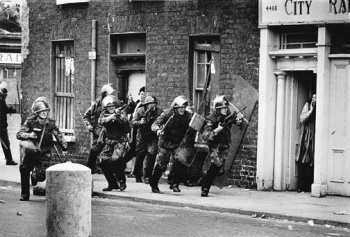
* closer to home, created some of the most memorable images of the early Troubles in Northern Ireland, during a riot in Derry, was blinded by CS gas and recovered in a dingy house which reminded him of his working-class upbringing in London and has said that : "I was caught between the two sides, with the Provos warning me off one day and the British army chasing me the next."

* had his beloved Nikon F camera fractured by a sniper's bullet in a rice field in Cambodia in 1970 just as he held it up to his face.

* wounded and in a field hospital in Phnom Penh in 1970, having been hit by fragments of a mortar shell, said that he was most afraid, when he was captured by Idi Amin's soldiers in Uganda and held prisoner for four days : "They dug pits outside our cell. The sense that something awful was going to happen was constant and almost overwhelming."


* took the photographs of Maryon Park in London which were used in Antonioni's film 'Blowup'.
http://vimeo.com/11274009

* in 1982, was refused a press pass by the British Government to cover the Falklands War, believing it was because the Thatcher Government felt his images might be too disturbing politically but finding recently that he was turned away simply because the Royal Navy had used up its quota of press passes.

Has said : "Photography for me is not looking, it’s feeling. If you can’t feel what you’re looking at, then you’re never going to get others to feel anything when they look at your pictures."

Article in Gaurdian newspaper and link with John talking :
Gaurdian
http://www.guardian.co.uk/artanddesign/2010/feb/07/don-mccullin-shaped-war-review

Don talking about social documentary photography :
http://www.youtube.com/watch?v=wrP7Z6FUxZQ


Britain is a country where old men say "Goodbye" to Diane Cilento with memories of the beautiful woman they lusted after when they were boys

Diane Cilento has died at the age of 78.
I was 16 years old in 1963 and Diane Cilento was 30 when she played 'Molly Seagrim', who seduced Albert Finney as 'Tom Jones' in the film 'Tom Jones' and was nominated for an Oscar for her performance.

Things you possibly didn't know about Diane, that she :

* was born in Brisbane Australia, daughter of physicians, Sir Raphael and Lady Phyllis Cilento who, much to their initial disappointment, she didn't follow into the medical profession, but won a scholarship to the Royal Academy of Dramatic Art, London, at the age of 17 and started to get parts in film, theatre and television. parts.


* got her first leading part in 1955, at the age of 22, in 'Passage Home', the only woman on a cargo ship from South America to London where her sultry presence got the crew all steamed up, especially Captain Peter Finch and First Mate Anthony Steele.


* after several forgettable films, played Molly Seagrim in Tom Jones, where, in a dark wig and exuding vitality, she was the first of many women to seduce the young eighteenth century hero.
http://www.youtube.com/watch?v=tezjznL9NzM&feature=related*


* in 1957 met, then married Sean Connery and then made a brief sortie into Hollywood which started in 1965 with Carol Reed's 'The Agony and The Ecstasy', in which, as the Countess de Medici, she encouraged Charlton Heston's 'Michelangelo' to finish painting the ceiling of the Sistine Chapel.


* in 1967, as a widowed landlady, starred opposite Paul Newman in the western,'Hombre' and then back in Britain made the cult film, 'The Wicker Man', in 1973 having fun as the schoolteacher on a pagan Scottish island, who upsets the repressed religious police sergeant by her teaching her girl pupils about phallic symbols.

Singing with Christopher Lee :
http://www.youtube.com/watch?v=krpjL91U_DE

* after her divorce from Sean Connery, returned to Australia, played in the theatre and in 1980s, settled in Queensland and built her own outdoor amphitheatre in the rainforest called the Karnak Playhouse.

* played the mother of her real-life son, Jason Connery in her last film in Australia, 'The Boy Who Had Everything' in 1985.

Diane talking about points in her life :
http://www.australianbiography.gov.au/subjects/cilento/videos/1/

Australian news remembering Diane :
http://www.youtube.com/watch?v=J849UiTiL-c

Saturday, 8 October 2011

Britain is still a country where some old men receive a 'christmas hamper'


This question appeared in the Guardian newspaper last week :

What are the best things to put into a Christmas hamper?

At our children's home we make hampers for elderly people in the area. We want to buy things that will be welcomed and not too expensive ?


It elicited this prize winning response :

For Men:

Fray Bentoss Meat Pie
Spam
Saga Magazine
150 Marlboro Light
Newcastle Brown Ale
Aniseed balls
The Sun