Sunday, 18 September 2016

Britain is no longer a country for and says "Farewell" to the Grand Old Man of Myrmecology and the World of Ants, Cedric Collingwood


Page views : 1499

Ants are important. They are one of the great success stories in the history of life on Earth. Living ants are currently classified into 21 subfamilies and 283 genera and Cedric Alex Collingwood, who has died at the age of 97, studied them and extended our knowledge of them in many parts of the world over a period of least seventy years.

As an ant expert, Cedric recognised their importance occupying keystone positions in most terrestrial environments, but also that our understanding of their diversity patterns, evolution and ecology is far from complete, a state which undermined their potential utility in land management and conservation. It is estimated that only half of the world's ant species, currently numbering about 11,700, have been described. Cedric's discovery of new species added to that total and he played a major role in recognising that a more complete inventory of the world's ant fauna was essential. An example of this was his discovery of Lasius Balearicus on the Island of Majorca in 1982 and recognised new species in 2014.


Cedric's death has gone unreported apart from a notice in 'UK Wood Ants' which read : 'We are sad to report the death of Cedric Collingwood, renowned ant expert and entomologist. Cedric's work on the taxonomy and distribution of ants spanned more than sixty years and ranged from the Scottish Highlands to the Himalayas.'

He was born Cedric Alex Collingwood in Lewisham, South London, just after the end of the First World War, in the first quarter of 1919. His middle name was abbreviated from 'Alexei' and he was the son of Lawrance Arthur and his wife Anna who had been born Anja Koenig. Lawrence had started his musical career as a choirboy at Westminster Abbey from 1897-1902 and went on to study at the Guildhall School of Music and Exeter College, Oxford from 1907–1911. It was then, at 24, he went to Russia and enrolled for study at the Saint Petersburg Conservatory and worked there until 1919 as a conductor, but also served as interpreter for Winston Churchill's expedition in support of White Russian forces in Northern Russia. War. It was while he was in Russia that he met and married Anja and returned to Britain where Cedric was born in 1919.

His career in music prospered. He built his reputation, at first as a composer : his 'Symphonic Poem' was presented by the Royal College of Music and he himself conducted its professional premiere at the Queen's Hall when Cedric was three years old in 1922. He went on to conduct opera at the Old Vic and Sadler's Wells Theatre, becoming principal conductor in 1931 when Cedric would have been twelve and three years later he conducted the London Symphony Orchestra in a recording of the 'Triumphal March from Caractacus' and the 'Woodland Interlude' by Sir Edward Elgar, supervised by the composer himself by telephone from his sickbed before his death a month later.

Like Cedric, Lawrance lived a long life and died at the age of 95 in 1983 and Anna died at the age of 91 in 1987.


Cedric himself must have served his country in the Armed Forces during the Second World War and he studied at University for a Bachelor of Science degree after the War. By the 1970s, when he was in his fifties, he was working for the Agricultural Development Service in Leeds and in the 1980s he was conducting his research at the City Museum, Leeds. By this time his reputation was such that he was receiving specimens from, for example, the Natural History Museum in Basel and Dr Baroni Urbani's expeditions to Bhutan, Nepal, Northern India and Pakistan.


He made his first recorded appearance in the entomological world at the age of 31 in 1950 with the publication  of his 'Ants in N. Scotland' in the Entomologist's Record and Journal of Variation, a bimonthly, peer-reviewed entomological journal. In 1954 it was 'Rare ants in Dorset' for the 'Entomologist's Monthly Magazine' followed by 'Ants in the South Midlands'. Then, working with J.E.Satchell, came 'The wood ants of the English Lake District' published in 'North Western Naturalist' before he crossed the Channel for 'Ant hunting in France' and 'A rare parasitic ant in France' in 1956.

As an entomologist, Cedric probably lamented what he called the 'paucity of ant species in Britain north of an approximate line from the Wash to the Mersey' which was 'at least partly attributable to the low summer sunshine and temperature'. He was more than rewarded by the sun when his 'Survey of Iberian Fomicidae' was conducted on a journey across the Central Pyrenees in 1957,

In 1958, he crossed the Irish Sea to 'A survey of Irish Formicidae' published in the 'Proceedings of the Royal Irish Academy' and in which he thanked the Academy for a grant from the 'Lloyd Praeger Fund' towards the expenses of his three week survey. It was then north to the Baltic states and 'Scandinavian ants' and 'Ants in Finland.'

The 1960s brought  'Ants in the Scottish Highlands' and 'Some ants from North-East Asia',  'Notes on some South European and Mediterranean ants' and 1963 brought 'Three ant species new to Norway.'

In 1964 he spoke at the XIIth International Congress of Entomology in London and in 1970 the first European Regional Congress of Myrmecology, the year in which he published 'Formicidae of Nepal.'


1974 saw his 'A revised list of Norwegian ants' and the  following year saw his 'Handbooks for the identification of British Insects' with Barry Bolton and then his work in Spain produced 'A provisional list of Iberian Formicidae with a key to the worker caste' two years after that, 1976 and 1981 had seen him produce 'Ants from Korea' while 1982 had seen 'Himalayan ants of the genus Lasius.'

We catch glimpse of Cedric in the early 1980s when he had a big influence on the ten year old Jonathan Hughes, the future Scotland Wildlife Trust, Director of Conservation. He still remembers the exact moment when, standing in a stretch of ancient woodland by the River Lyon in Highland Perthshire he decided what he wanted to do in life.“Being shown how to identify different species of ants was a little like learning a language. As I learned the words for individual species I found I could start to construct sentences about the ecology and history of habitats and even entire landscapes.”
 He was with Cedric, a family friend and at their feet was a mound of earth and pine needles, crawling with industrious ants. Cedric explained how special these ants were to the woodland ecology and showed Jonny how they spray formic acid at any threat, including a hand held over the nest. He picked up one of the ants and showed him how to note the subtle differences between the Northern Wood Ant and the Scottish Wood Ant. A whole new world of  the study of ants,myrmecology, opened up to Jonny as he stared through Cedric's hand lens. He recalled :

In addition, Cedric gave Jonny also remembered "him explaining that what remained of the Caledonian pine forest was dying on its feet because it was being neglected. It was almost as though the penny dropped in my mind. I thought about how tragic this was and decided to actually try and do something about it.”

The 1980s brought publications on ants ranging from Yorkshire to Malta, Saudi Arabia, 'The ants of the Wahiba Sands,Oman' and the 1990s the Greek Islands, Cape Verde Islands, Yemen, Israel, Sweden, Yugoslavia and in 1998, 'A guide to ants of continental Portugal.'

The millenium saw 'Ants from Northwestern China' which he visited with American reaercher, Harold Heatwole.. Their funding came from Chinese, Australian and North Carolinan research sources and they were provided by living and research facilities by the Xinjiang Institute of Biology, Pedology and Desert Research in Urumqi and the Fulang and Muosuowan Biological Stations.

The millenium saw 'Ants from Northwestern China' and 'The ants of Niue, south west Pacific' which identified 28 species, 14 of which had not been recorded before and in 2004 at the age of 85 'The ants of the Socotra Archipelago.'

In an article about the blood-red robber ant found in Wyre in the Midlands, Mike Bloxham reported that Cedric 'doyen of today's British scholars in the field still makes occasional visits' 


This photo of Cedric at the age of 86 in 2005 clearly shows that he was still active in the field under a hot sun and in 2010 along with Aldawood nd Sharaf he had a claim in identifying a new species of ant in the Yemen which was distinguished from its closest relative by : 'Eyes oval, relatively large with eleven ommatidia in the longest row; Petiole node high and pointed in profile; Head, mesosoma and waist distinctly shagreenate granulate. Gaster finely shagreenate. Head dorsum, mesosoma, petiole, postpetiole and gastral tergites without hairs.'  A good example of the poetry of  Myrmecology


In 2010 he worked with H. Ghahari on 'A study on the ants of Southern Iran' and his last publication, 'New synonyms of two Arabian ants of the genus Monomorium Mayr' was in a collaboration last year.

In 2011 Jonathan Hughes visited his old mentor Cedric and was delighted to find him still looking at ants through his microscope: “As ever, he was at the kitchen table with ants from Saudi Arabia preserved in endless tubes of alcohol, mounting them on bits of card to identify them for researchers around the world. He is still working at the age of 93!”


Thursday, 15 September 2016

Britain is a country and no country for two old BBC Commentators called Henry Blofeld and Jeremy Paxman

Henry Blofeld, who is 76 years old and has worked as a cricket commentator for the BBC Radio programme, 'Test Match Special' for the last 44 years, is not a happy man. The told the 'Radio Times' magazine that he would head to India to commentate on England’s winter tour of the subcontinent, but was sad about not being given the chance to work on one-day games. He said : “I always rather wish I was there, but I think they feel perhaps that I’m a bit too old, don’t you? They don’t ask me now and they’ve got so many newcomers, they don’t want an old fart like me.” The BBC confirmed this when on source said : “We pick the team that is best suited to the type of cricket that is being covered.” At the same time they were quick to point out that : “Henry absolutely remains an important part of our cricket coverage and is a much-loved member of the Test Match Special team.”

Twenty-20 cricket, played over one day, was introduced by the England and Wales Cricket Board in 2003 for inter-county competition and its success has seen its spread around the cricket world.  A typical game is completed in about three hours, with each innings lasting around 75–90 minutes and a 10–20-minute interval. This is much shorter than previously-existing forms of the game and is closer to the time span of other popular team sports. It was introduced to create a fast-paced form of the game which would be attractive to spectators at the ground and viewers on television. It was introduced at the international level in 2007 and Henry has made it clear he doesn't like it and has disparagingly described it as “showbiz, pure and simple…its only worthwhile job is to raise money” and told The Telegraph in 2014 that a dominance of the short form of the game would lead to "standards falling alarmingly".

At 66, Jeremy Paxaman is Henry's Junior by ten years and unlike Henry, his career has mainly been as a commentator on BBC TV. Unlike Henry, his gripe is not with their employer, but with, 'Mature Times', which apparently is the largest free publication targeting the 50+ demographic in Britain with 200,000 copies published monthly and over 600,000 readers across the online and digital editions.

Jeremy recently checked into a hotel and found 'a pile of free copies of the paper, which calls itself  'The voice of our generation' 'Oh God', I thought, the cheeky bastards are including me. Back off. For this must be the most unfashionable publication in Britain. Who wants to be "mature", like an old cheese ? We all know that "mature" means on the verge of incontinence, idiocy and peevish valetudinarianism. They might as well have name it the Surgical Stocking Sentinel or Winceyette Weekly.'

Jeremy's use of  'valetudinarianism' , the state of 'constantly and morbidly concerned with one's health' is befitting someone who still chairs the BBC's 'University Challenge'. He went on : 'The paper is adorned with advertisements for hearing aids, recliner chairs, copper insoles, stair lifts, devices to help you in and out of the bath and Your Life After Death, a book written by someone called 'Joseph' who apparently, is dead. I should rather be keeping company with Joseph than looking forward to any of these products : Why do the people who run these dreary publications assume that, apart from a cruise somewhere in the company of other virtual corpses, this sort of stuff is all we want ?'

Its publisher, Andrew Silk, hit back at Jeremy with : 'He is 66, so he obviously does not see himself as one of the people he wants to poke fun at, which is irrational.' He wrote :  'I suspect that with the high media profile enjoyed by Mr Paxman, comes a massive ego as well - but perhaps it's time for that ego to contemplate a little. 'Mr Paxman, you have just insulted over 21 million people (yes that's how many over 50s there are in the UK), you have called them 'cheesy and on the verge of incontinence' and I'm sure, on reflection you may regret such a statement.'

Methinks Jeremy has no regrets.

Wednesday, 7 September 2016

Britain is a country which says "Farewell" to an old son of Yorkshire, author-illustrator of children's books and magician of colours, Brian Wildsmith

Page views : 978

Brian, has died in Grasse in France at the age of 86, after a life which saw him produce over 80 illustrated children's books which have sold worldwide in their millions and have been translated into more than 30 languages.

Brian was born in the town of Hoyland, South Yorkshire in 1930, the son of a miner who worked at the local Elsecar Main Colliery and into a Christian household and was, in his words, brought up as ‘a cradle catholic’ on Bible stories which, in his opinion, were 'some of the best in the world.’ He maintained that the people, surrounding landscape and climate of Hoyland left an indelible mark on his later art. He remembered that "Everything was grey. There wasn't any colour. It was all up to my imagination. I had to draw in my head,"

He had first encounter with St. Francis of Assisi when, as a young boy, taking his first communion in St. Helen's Catholic Church in Hoyland, he recalled kneeling at the edge of the altar rails, feeling more embarrassed that the holes in his shoes could be seen by the congregation, than terrified at receiving the Host for the first time, when, looking to his right, he saw a statue of St. Francis, a lamb in his arms and a squirrel perched on his shoulder. He had a look of kindness on his face and although his clothes were shabby and drab, he didn't seem to mind, It forced Brian to say : "Why should I worry about the soles of my shoes?" and consider that St. Francis seemed be saying : "It's not the soles of your shoes but the soul within your body that I am looking at." The statue inspired Brian so much that he would later research the life of the Saint and undertake visits to Assisi.

After attending St.Helen's Catholic Junior School in Hoyland (right), at the age of eleven in 1941 and in the second year of the Second World War, he went on to study at the catholic De La Salle College for Boys in Sheffield where his talents pointed to a future career either in music or science.  He hadn't intended to be an artist since "The art at school was a disaster. All we did was sit in a circle around cubes and triangles and draw them in different positions. It was during the War, so paper was scarce and it was difficult to get paints, but I used to spend my time drawing battle scenes between airplanes and warships." 

It was, however, a last-minute calling which prompted him to drop his plans to be a scientist : "One morning I was going into a physics class and I remember thinking 'Is this really what I want to do with my life?' and the answer was : 'No. I want to create.'"  As a result, from the age 16 to 19 he studied at the Barnsley School of Art.

It was also while he was a seventeen year old that he met AurĂ©lie Ithurbide, the fourteen year old daughter of the French chef at the 'great house', Wentworth Woodhouse, He was sketching some ancient statues in the grounds, when her freckled face peered over his shoulder to glimpse his work. When he allowed her to flip through his sketchbook, she smiled with approval. They were to marry eight years later, when he was 25 and remained together for 60 years until her death last year.

In 1949 he won a scholarship to study at the Slade School of Fine Art where Sir William Coldstream was among his teachers and where, as its Principal, he led it on the path to achieve an international reputation. As a working class lad from Yorkshire, however, Brian felt he didn’t fit in with the ‘public school types’ at the School where even a shared interest in cricket failed to break the ice. In addition, canvases and paints were expensive so initially he concentrated on drawing and spent a lot of time in the print rooms of the British Museum and the National Gallery, familiarizing himself with the works of the old masters.

He completed his studies at the Slade in 1952, graduated with a fine arts degree and then spent his two years National Service teaching maths with the Royal Army Education Corps followed by a posting teaching at the Royal School of Music in Twickenham. Then in 1955, he married Aurélie and began teaching at Selhurst Secondary High School for Boys in Croydon, South London. In his spare time he began designing book jackets, the first of which was 'Daffodil Sky' by H.E.Bates. He produced work for the publisher John Murray and honed his graphic skills on black and white line drawings for children's books published by Faber and Faber, Penguin Books and Oxford University Press.

Brian's first love was for painting and he was eager to illustrate books in colour. Mabel George of Oxford University Press, whom he first met in 1957, gave him his first opportunity when she commissioned from him, as an experiment, 12 colour plates for 'Arabian Nights' in 1961.The publisher was pleased, but the luminosity of his paintings and his loose graphic style failed to impress the reviewer in the TLS who dismissed them as ‘pointless scribbles’. Brian was dismayed, but Mabel George wasn’t bothered and later said : ‘I knew we had something interesting on our handsand that review has convinced me’ and commissioned Brian to create his 'ABC'. At the time and now supporting a young family, he was still teaching for one day a week at Maidstone College of Art to supplement his income.

In Brian's opinion : "The logical function of an ABC is to teach. To teach how? Through basic shapes, colours and textures. It was a new concept: to produce pictures of value in their own right which would stimulate and excite children. And I wanted a new design. Most ABCs say 'A is for Apple.' A is not for apple. A is for A. I wanted this book to say that."

Brian would maintain that this was his best book : "It was the time of Carnaby Street and The Beatles. There was a new era of creativity in England, and that book was the beginning for a creative expanse of children's books." In addition, he admitted that because he was new to making picture books and knew nothing about the process he was ‘unaware of the constraints – I wasn’t bound by convention, I just went my own,
admittedly somewhat arrogant way. This was the 1960s remember! Liberation! The age of freedom and self expression!’ His book won the prestigious Kate Greenaway Medal in 1962, the year after it came out. The award had been established by the British Library Association in 1955 for 'The Most Distinguished Illustration of a Book for Children.'

Now, Mabel George, encouraged Brian to turn his hand to writing, as well as illustrating stories. He recalled : "I said, 'But Mabel, my English is terrible. I always got terrible marks at school.' But she said, "Brian, I have editors with inkpots full of full stops and commas. It's ideas that count and you've got them." And it took off from there."

It was a perfect opportunity. Brian believed that : ‘Art is food for the soul and a picture book represents a child’s very first encounter with art, so I felt this was a way I could make a contribution to the world. A drop in the ocean maybe, but this work offered a chance to communicate to children the importance of such things as kindness, compassion, friendship, beauty.’'

His retelling of five fables by Jean de la Fontaine included 'The Lion and the Rat', which received a Greenaway Medal Commendation in 1963. His books 'Birds', 'Wild Animals' and 'Fishes' all appeared in 1967, with the former gaining another Greenaway Commendation and also the New York Times award as 'Best Illustrated Book of the Year.'

1971 was a turning point for Brian. He published 'The Owl and the Woodpecker' in which, for the first time he illustrated a story he had written. It gained another Commendation. In addition, at the age of 41 he bade "Adieu" to Britain and moved to the South of France where he lived at Castellaras, a hill village near Cannes and Grasse, with Aurélie and their four children and where he hoped to gain fresh inspiration for his art and writing.

Brian also thought that in Britain "there is a dividing line between artists and illustrators, who are thought inferior to painters. Well, that's absolute rubbish. Some of the most creative work is being done in children's books. In Japan, everything is art. They don't say painting is better than ceramics or dress design."

His 'Little Wood Duck' came in 1972 and in 1974 he received a telegram, out of the blue, from the American film director, George Cukor, inviting him to design sets and costumes for a film of Maeterlinck’s 'The Bluebird'. It was irresistible; he met the stars including Jane Fonda, Elizabeth Taylor and an eight-year-old Patsy Kensit. It was filmed in Leningrad but although it provided Brian with some conversational anecdotes, the film was not a success. https://www.youtube.com/watch?v=mwc4QvATcnU&t=11m54s

Then it was 17 years before he returned to the stories of his youth when he was a 'cradle catholic' : 'A Christmas Story', a retelling of the Nativity from a child's perspective in 1989 followed by 'The Easter Story' in 1993, 'Saint Francis' in 1997, 'Exodus' in 1998, 'Jesus' in 2000, 'Mary' and 'Moses' at the age of 77 in 2007.

Brian's work was popular in Japan and in 1994 a 'Brian Wildsmith Art Museum' was opened in Izu-kogen, south of Tokyo, Japan and in 2003, the exhibition : 'Fantasia from a Fairyland: Brian Wildsmith and His World of Illustrations and Picture Books' opened at the Tokyo Fuji Art Museum in Hachioji to celebrate 40 years of his author-illustrator career. In a message written for the exhibition opening, he said :
'My life has been dedicated to producing picture books for children that I hope reflect this love, helping them observe, comprehend and appreciate the wondrous world that they have been born into. I want to help them climb the mountain of life and reach the peak of enlightenment and fulfilment. This is the basic right of every child born on our Earth.'

It was not until 2010, when Brian was 80, that there was the first serious exhibition of his work at a London gallery and the first time his original illustrations were on sale in Britain followed by another show at Seven Stories, Newcastle's 'Museum of Children's Books' (left).

At the time he said : "I've never been invited to do an exhibition or do a talk in England, except once, about 10 years ago. I've given talks all across Canada, many in the United States, South Africa, Singapore, Hong Kong, Japan – but not England. There, people want me out of the way because I'm a threat to their Comic Cuts attitude to children's books. Not that there's anything wrong with comic books or Mickey Mouse, but it just another different side to producing works for children. I mean, I don't dislike those, I like Mickey Mouse, but there's another side. It's like food. I mean, do you just let your kids eat lollipops and ice cream or do you give them nourriture?"

Ultimately it is Brian's beautiful illustrations, imbued with 'inner soul', his 'nourriture' for children which will survive him. He believed :

"The stories in my paintings are about the world in which we live. Everything is living : animals, birds, bees, people, flowers and each has its own soul. I try to express that inner soul. I believe that beautiful picture books of the right kind are vitally important in subconsciously forming a child's visual appreciation, which will bear fruit in later life."

Friday, 26 August 2016

Britain is a country with a county called Kent and a district called Shepway which is no place for old men

Researchers from the family history website 'Ancestry' have looked at England and Wales death indexes from 1837 to 2007 and during that time span, average life expectancy across the whole of Britain rose from just 40 to 78. Obviously, old men and women in these parts of Britain are living a lot longer now than they did in the past in response to better standards of living and advances in healthcare. There is, however, one district which lags stubbornly behind the rest when it comes to longevity at it is Shepway in the County of Kent. Here the average life expectancy over the 170 year period is just 41 years.

On the other hand, those lucky to be born in the coastal market town of Teignbridge in the County of Devon, had a life expectancy which was twice as long, averaging 82 years and Colwyn in Wales and Rushcliffe in Nottinghamshire were not far behind with an average lifespan of 81.

Shepway is a local government district in Kent, with its council based in the seaside town of Folkestone. It has a population of 109,452 and although it has a proportion of old men and women past the age of 70, it is not a large share. It is not surprising to find that, in economic terms, Shepway is the third most deprived area in Kent, after Thanet and Swale. Like them, it has a high rate of unemployment, poor educational attainment figures and with the majority of businesses being small operations.

In addition to the towns of Folkestone, Hythe, Dymchurch and New Romney the men and women of Shepway who are destined not to live long lives live in villages with ancient names : Brenzett, Paddlesworth, Postling, Snargate, Stelling Minnis and Stowting. If there was wealth here once, it has long since gone, since Romney Marsh once had a number of communities extensively built in the medieval period and 17th century as centres of the Romney Marsh wool trade.

The fact that the old men and women of Shepway will not live long lives is doubtless connected to the fact that many of them began life in poverty as indeed 23% of Shepway children do today, against a national figure of 20.2%.

Britain, a country where longevity is not only linked to the accident of birth but also the accident of location.

Wednesday, 24 August 2016

Britain is no longer a country for and says "Farewell" to an old black and white photographer and son of Clerkenwell called Colin O'Brien


Colin, whose career as a photographer on the streets of London spanned 68 years, involved taking photos, both digital and film and processing and printing his work in the traditional way in a darkroom and showed his work in more than 30 exhibitions, has died at the age of 76.

He was born in the second year of the Second World War in 1940, at home, in Northampton Buildings Clerkenwell in Central London an area known as 'Little Italy' and he recalled : “My family all worked in the area so my mother let them know the baby had arrived by hanging something in the window. I think it was just an old shopping bag!”

His childhood home was on the top floor of Victoria Dwellings, built as model housing in the mid-19th century to provide healthy homes for the labouring classes, sited at the junction of Clerkenwell and Farringdon Roads, just a stone’s throw from Hatton Garden, where priceless gems have been bought and sold since medieval times. He recalled : "I grew up in Little Italy. It was full of Italian immigrants, they came from a very poor area of Italy to a very poor area of London thinking that their lives would be transformed."

While his father was away as a conscript fighting during the War, his mother and her sister Winifred, stayed in London for most of the duration of the Blitz. “For my safety they did go to Ifracombe, Devon in 1941, but they hated the landlady and so they came back to London saying they’d rather ‘take their chance’.” It was a precarious existence : Clerkenwell had the flimsy Anderson bomb shelters and he recalled : “My granny lived in the middle of  Victoria Dwellings all the families from the top floors, and the families from the bottom would go to her flat. The grown ups would make tea, chat and reminisce. It was that feeling of being together, and being safe.”


Colin came to photography more by accident than design : "There was no real artistic backup in the family. I already had a box camera, it was just lying there and I just started photographing my mates. There were two things that got me into it : one of my uncles, Patsy, worked in the print and he used to bring magazines home. One of those magazines was Picture Post and I used to love looking through it. So that might have been some sort of early motivation that got me taking photographs of my surroundings. Being stimulated by the pictures of Bill Brandt and Bert Hardy isn’t a bad start."

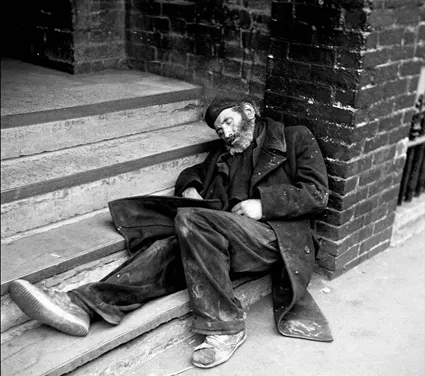
In 1948 he took a photo of his friends Raymond Scalionne and Joe Bacuzzi leaning against a car in Hatton Garden and from the same time he recalled : "Two of my friends sitting on the steps of Onslow Street which is where we used to play and these were taken in 1948. I was eight years old when I took them and I often get asked by students of photography today "How did I get so close to society's outsiders ?" and to me they weren't outsiders because they grew up with those sorts of people and they were all poor. We were all in the same boat. I never knew anybody who had any money in those days."
https://www.youtube.com/watch?v=YYKVYIch7XM&t=1m55s

He recalled : "There was an Irish guy, lived in the block in Victoria Gardens. I think he was a chaufeur and think it was he who sold them or gave them for a much lesser amount of money than it was worth, this lovely Leica IIIB or IIIA, I can't remember what model it was, this camera which I then used after the box camera so from the sublime to the ridiculous from a box camera to a Leica." 
https://www.youtube.com/watch?v=YYKVYIch7XM&t=1m02s

“Then another uncle, Will, a black cab driver, arrived one Christmas with a little contact printing outfit. Contact printing involves a technique where you don’t need a proper darkroom, because the paper is not that sensitive. He just mixed up these chemicals. He obviously knew something about it. We put one of the box camera pictures in a small wooden printing frame, held it up to the light for about 10 minutes and then we processed it and I saw this image coming through in the developer."

Now, at the age of 14 and armed with his Leica camera with its 3.5 Elmar lens, Colin realised "that there was more to photography than just taking pictures of my friends and family, although many of my favourite pictures are of friends and family. Beyond that, people began to tell me they liked my work so I began to take it more seriously.”


There were photos of : "Stoic Mrs Leinweber who lived beneath us waiting at 12.30 to dish out shepherd’s pie and peas with her huge arms” or "my mum cooking or trying on a hat."

Sometimes things were more  dramatic : "I would hear a bang, get the camera and then look down, see a car accident and take a picture. I took a wonderful picture of a three-wheeled van toppled over in Clerkenwell Road." 

He spent so much time on his window perch that : “My mother used to say, ‘Colin! You’ll fall out one day!’ But it was a beautiful perspective from which to see the world, and I never tired of it.”
Colin was 22 when, from the window, he took : "One lovely picture of New Year's Eve 1963. It had been snowing most of the afternoon and it was twilight and I leant out the window and there was hardly anybody an the street and there was one pedestrian crossing and the snow was beginning to settle and it was the last few hours of 1962."
https://www.youtube.com/watch?v=YYKVYIch7XM&t=8m21s

From the window he also took : "The daytime accident picture. There was little boy in one of the vans and we learnt later that he had unfortunately died."
https://www.youtube.com/watch?v=YYKVYIch7XM&t=8m48s

and :
"The night time  accident was amazing because it was a night time exposure and you could see traces of cars and also if you look at the people they're very shadowy. Some people stood still and some moved and the ones that had moved are obviously slightly blurred."
https://www.youtube.com/watch?v=YYKVYIch7XM&t=9m11s

Initially his school days in Little Italy were unhappy : “There were lots of Italians and kids with no clothes or shoes and we would all use the bombsites as vast playgrounds. Then there were the Roman Catholic schools with nuns that knocked the living daylights out of you. I went to one as an infant, but I cried most days because I just hated it.” His secondary modern school was better, although he left at the age of 15 in 1955 without qualifications. At first he had a series of jobs, as a tea boy, then as a runner at one of many press agencies near Fleet Street until, as he recalled : "I had a nice personality, so in my early twenties I worked with the City Literary Institute and Mrs Daley sent me to Media Resources.”

Colin found that his parents didn't share his photographic aspirations and he was sympathetic to their point of view : “They spent their days trying to earn a living, trying to keep us alive." His father, in particular, showed little understanding : "I never really got on with my Dad early on in my life. I was fairly creative and he worked in a pretty mundane, awful job so I was never sure that he got what I was doing.”

Having discovered that he could get time off work to study, he got himself school qualifications and after travelling around Europe in the early 1960s, took a BA in Photography at Westminster Polytechnic and then an MA in 'Photography and Advertising' at the London College of Printing at the Elephant and Castle where he also worked as a media resources technician.

Colin was never a full time photographer, His work was done when, for two hours or so every day, he would walk the streets with his camera, taking photographs of people who interested him. He recalled : "I wasn’t Don McCullin going off to war or David Bailey photographing celebrities. I was quite provincial. I didn’t go south of the river and I didn’t travel. I photographed what I saw, people acting out the drama of everyday life."

A good example of his street work came in 1986 : "This is the corner where I took the picture of mine called 'Comings and Goings' Everybody's about to do something or go somewhere or coming into one side or leaving out of the other side of the frame and there's only one little old lady sitting in the middle, not going anywhere and doing anything. She's got her shoes off and she's sitting there watching the world go by."
https://www.youtube.com/watch?v=YYKVYIch7XM&t=3m23s


Colin was philosophical about the popularity of his art : “My sort of pictures people didn’t want to have. Now people have a soft spot for the old days, it’s nostalgia. It wasn’t as good as they think! I took pictures of the threadbare years, the 1950s and the down and outs in the street, but there are still down and outs, sometimes even sitting in the same places. I’m a poor boy from Clerkenwell but just last night I was drinking champagne at the new Leica store at the Royal Exchange where they are showing some of my photographs."

Last year Colin said of London :  "At certain times the city has a stillness and beauty about it, but mostly it is on the move, at times frenetic, exasperating and tiring. But for me it is where I was born and where I grew up and it will always be my home."

"The great photographers are the ones that can pick out from that mass of information can just isolate something  for a moment a second, That's the trick : isolating something that makes a wonderful composition, has something to say."
https://www.youtube.com/watch?v=YYKVYIch7XM&t=12m40s

Some years ago and a few weeks before the death of his father he recorded : “He came to an exhibition at the Morley gallery and he wrote in the comment book: ‘I am very proud of my son, these pictures are wonderful.’ It was so nice to see that.”

* * * * *
Friday, 13 June 2014
Britain is no longer a country for and says "Goodbye" to an old artist-photographer, once 'Laureate of Teenage London' called Roger Mayne
http://britainisnocountryforoldmen.blogspot.co.uk/2014/06/britain-is-no-longer-country-for-and.html